


Water Is Becoming a Financial Risk: Why Capital Needs to Flow Into Resilience Now
Too little water stalls economies. Too much destroys infrastructure. What happens when a region faces both — sometimes in the same year?
That question is no longer hypothetical. Low water levels on European rivers have already disrupted entire supply chains. Extreme floods have shaken regions economically and socially. Industrial companies are increasingly factoring water availability into site decisions. Water is no longer just an environmental resource — it is becoming a strategic factor for business, infrastructure and financial markets.
One figure makes this especially clear: around 50% of global GDP — roughly USD 44 trillion — depends directly on functioning natural systems, and according to the World Bank, global water demand will exceed supply by 40% by 2030. In Europe, 20% of land and 30% of the population are already affected by water stress. At the same time, floods have caused more than €250 billion in damage across Europe since 1980, according to the European Environment Agency (EEA). Water is therefore both a scarce resource and an extreme risk — which is exactly why it is increasingly becoming an economic asset in its own right.
Water as a Financial Risk
Financial markets are beginning to recognise this reality. Water affects companies on several levels: production losses from drought or flooding, supply chain disruptions, rising insurance premiums, credit risk. For banks, insurers and investors, this means water is becoming a systemic risk.
This is where the principle of double materiality comes in — two perspectives that belong together: how does a company affect water, through consumption, pollution, or pressure on ecosystems? And how does water affect the company, through production risk, supply chain disruption, rising insurance and credit risk? This double perspective — anchored in ESRS E3 and the EU Taxonomy — makes water a fixed part of how companies are financially assessed.
Why Capital Still Moves Slowly
The interesting question isn’t whether the risks are known — they are, and have been for some time. The real question is why capital still moves so slowly despite that. My own observation: it’s rarely a knowledge gap that holds us back. It’s institutional routines and the path dependencies of an older economic paradigm — systems built to maintain existing infrastructure, optimise short-term costs, and repair risk after the fact, rather than invest in resilience upfront. The shift toward water-resilient systems is therefore not only a technical or financial task — it is an institutional and a mental one.
Regulation as the Game Changer
Modernising Europe’s water infrastructure and making it climate-resilient will require more than €255 billion in additional investment by 2030 — a sum municipalities cannot raise on their own. European financial institutions have a key role to play here: the European Investment Bank plans to invest €15 billion in water resilience by 2027, focused on flood protection, drought prevention and the renewal of ageing urban water networks. The European Investment Fund is mobilising additional private capital through guarantees and equity, working with commercial banks and infrastructure and impact funds — an important bridge between public investment and private capital markets.
One particularly interesting new development is Nature Credits, specifically for water: they finance projects that measurably improve the quality, availability or regeneration of water resources. The European Commission presented an initial roadmap for issuing these credits in 2025 — a new market that makes the restoration of nature financeable, and could create a new revenue stream for farmers or municipalities.
An Important Caveat
Across all of these mechanisms, one boundary remains important: water is not an ordinary economic good, and we should be careful about translating nature entirely into financial metrics. A river is more than a cash-flow variable. What matters is treating water as systemically relevant infrastructure — the basis of public health, a precondition for functioning cities and economies, and central to food security and social stability.
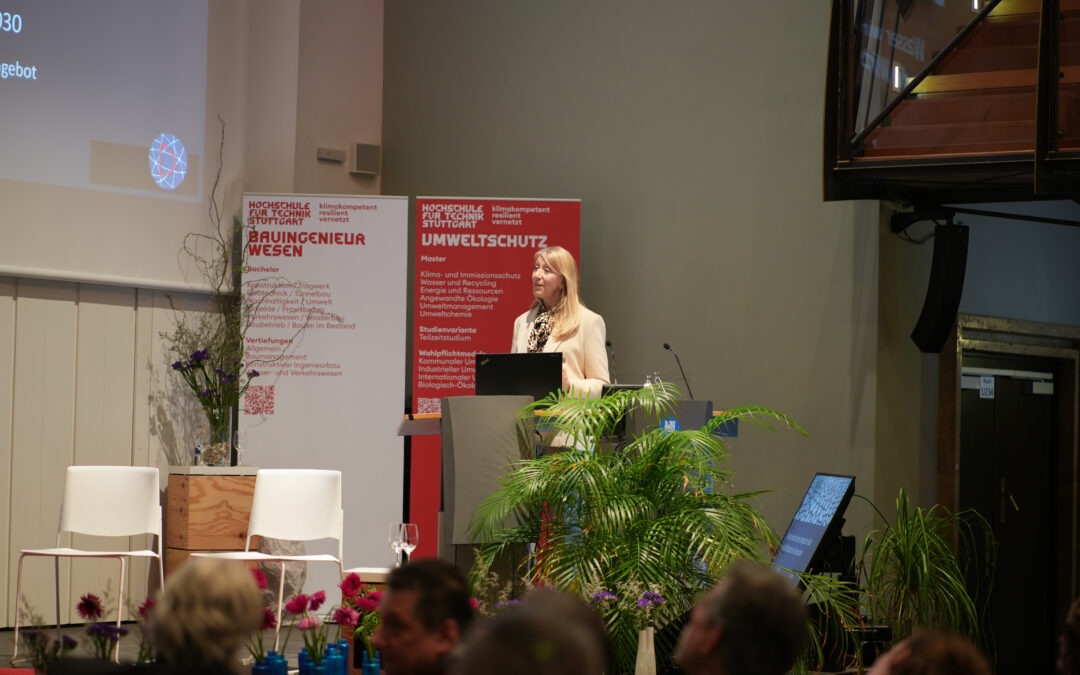
I presented these questions at the 4th Wasserdialog Forum at Hochschule für Technik Stuttgart, jointly hosted by Wirtschaftsförderung Region Stuttgart, HFT Stuttgart, the DWA, the Digital Water Institute and the IDG Water Network. With more than 140 participants from science, practice, administration and business, the discussion that followed made one thing clear: the central challenges facing the water sector are well known — the real task now is moving from describing the problem to actively shaping the future.
Full recap of the Wasserdialog Forum →
Sources: World Bank; European Environment Agency (EEA); European Investment Bank (EIB); European Commission.
Note for the designer: Text is final and can be used 1:1 on the website. Subheadings (bold/coloured) should be implemented as H2/H3 in the CMS. The closing link should open in a new tab.