


News
Market, capital and sustainability rules are shifting at the same time. Here I share my view on what that means for growth and investment decisions, along with publications, workshops and talks from my work.

The GoodCapitalist
Sustainable transformation is no longer a topic for the future; it is happening now – and it is hard work. Companies that fail to address it run the risk of falling behind. The good news is that artificial intelligence (AI) provides a powerful tool that can not only optimize processes but also strategically support change. But it takes more than technology—it takes attitude, orientation, and courage.
In conversation with The Good Capitalist, I share how companies can use AI in a targeted way to not only master sustainable transformation, but also actively shape it—with clarity, responsibility, and a spirit of innovation.
👉 Read the full article now at goodcapitalist.

AI in the Mid-Market
AI in the Mid-Market: Why Structure Matters More Than Technology
Many mid-sized companies hesitate to adopt AI in a structured way — rarely out of technology scepticism, but out of uncertainty: which use cases genuinely pay off? How do you stay compliant with the EU AI Act without overwhelming internal processes? And how do you stop a single pilot project from going nowhere?
My experience as a Certified AI Manager shows: the limiting factor is rarely the technology itself — it’s the missing structure to turn individual experiments into a company-wide approach. Three levels determine whether AI genuinely takes hold: employees’ underlying mindset, the practical skillset around how the tools work, prompting, and data security, and disciplined use of specific tools in daily work. Bringing these three together is what turns a one-off pilot into a resilient roadmap.

DNK platform for CSRD & VSME reporting
The German Sustainability Code (DNK) has launched a new platform that supports companies in implementing their sustainability reporting efficiently and in a practical manner – in accordance with both the CSRD and the VSME standard.
As an official training partner of the DNK, we support organizations in structuring their reports and meeting the requirements professionally. Particularly exciting: the VSME+ standard will soon be available and will contain additional practical elements.
The platform provides robust support, especially through its media library with a wide range of resources, such as:
• Instructions for double materiality analysis,
• Practical checklists and tutorials,
• Advanced tools and background information on CSRD implementation.
The double materiality analysis is at the heart of the platform: it assesses both the company’s impact on the environment and society and the risks and opportunities for the company itself.
Another advantage is that artificial intelligence (AI) can support data collection and evaluation, for example through the structured analysis of text and numerical data or the automation of data flows.
We explain more about this in our article in The Good Capitalist magazine. The Good Capitalist.
Water Is Becoming a Financial Risk
Water Is Becoming a Financial Risk: Why Capital Needs to Flow Into Resilience Now
Too little water stalls economies. Too much destroys infrastructure. What happens when a region faces both — sometimes in the same year?
That question is no longer hypothetical. Low water levels on European rivers have already disrupted entire supply chains. Extreme floods have shaken regions economically and socially. Industrial companies are increasingly factoring water availability into site decisions. Water is no longer just an environmental resource — it is becoming a strategic factor for business, infrastructure and financial markets.
One figure makes this especially clear: around 50% of global GDP — roughly USD 44 trillion — depends directly on functioning natural systems, and according to the World Bank, global water demand will exceed supply by 40% by 2030. In Europe, 20% of land and 30% of the population are already affected by water stress. At the same time, floods have caused more than €250 billion in damage across Europe since 1980, according to the European Environment Agency (EEA). Water is therefore both a scarce resource and an extreme risk — which is exactly why it is increasingly becoming an economic asset in its own right.
Water as a Financial Risk
Financial markets are beginning to recognise this reality. Water affects companies on several levels: production losses from drought or flooding, supply chain disruptions, rising insurance premiums, credit risk. For banks, insurers and investors, this means water is becoming a systemic risk.
This is where the principle of double materiality comes in — two perspectives that belong together: how does a company affect water, through consumption, pollution, or pressure on ecosystems? And how does water affect the company, through production risk, supply chain disruption, rising insurance and credit risk? This double perspective — anchored in ESRS E3 and the EU Taxonomy — makes water a fixed part of how companies are financially assessed.
Why Capital Still Moves Slowly
The interesting question isn’t whether the risks are known — they are, and have been for some time. The real question is why capital still moves so slowly despite that. My own observation: it’s rarely a knowledge gap that holds us back. It’s institutional routines and the path dependencies of an older economic paradigm — systems built to maintain existing infrastructure, optimise short-term costs, and repair risk after the fact, rather than invest in resilience upfront. The shift toward water-resilient systems is therefore not only a technical or financial task — it is an institutional and a mental one.
Regulation as the Game Changer
Modernising Europe’s water infrastructure and making it climate-resilient will require more than €255 billion in additional investment by 2030 — a sum municipalities cannot raise on their own. European financial institutions have a key role to play here: the European Investment Bank plans to invest €15 billion in water resilience by 2027, focused on flood protection, drought prevention and the renewal of ageing urban water networks. The European Investment Fund is mobilising additional private capital through guarantees and equity, working with commercial banks and infrastructure and impact funds — an important bridge between public investment and private capital markets.
One particularly interesting new development is Nature Credits, specifically for water: they finance projects that measurably improve the quality, availability or regeneration of water resources. The European Commission presented an initial roadmap for issuing these credits in 2025 — a new market that makes the restoration of nature financeable, and could create a new revenue stream for farmers or municipalities.
An Important Caveat
Across all of these mechanisms, one boundary remains important: water is not an ordinary economic good, and we should be careful about translating nature entirely into financial metrics. A river is more than a cash-flow variable. What matters is treating water as systemically relevant infrastructure — the basis of public health, a precondition for functioning cities and economies, and central to food security and social stability.
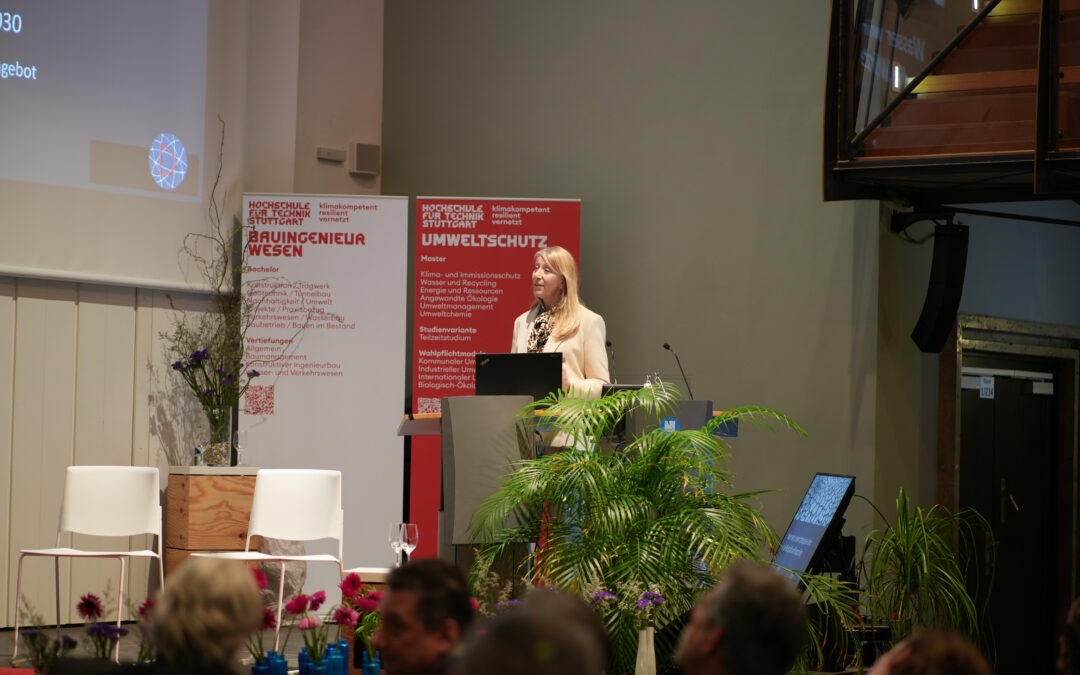
I presented these questions at the 4th Wasserdialog Forum at Hochschule für Technik Stuttgart, jointly hosted by Wirtschaftsförderung Region Stuttgart, HFT Stuttgart, the DWA, the Digital Water Institute and the IDG Water Network. With more than 140 participants from science, practice, administration and business, the discussion that followed made one thing clear: the central challenges facing the water sector are well known — the real task now is moving from describing the problem to actively shaping the future.
Full recap of the Wasserdialog Forum →
Sources: World Bank; European Environment Agency (EEA); European Investment Bank (EIB); European Commission.
Note for the designer: Text is final and can be used 1:1 on the website. Subheadings (bold/coloured) should be implemented as H2/H3 in the CMS. The closing link should open in a new tab.

Sustainability Software Readiness Workshop
Now available for booking
an online or on site 4-hour sustainability software readiness workshop
“Exploration of current sustainability management status and preparation for the selection process of suitable sustainability management software”
The challenge
The search for a suitable software solution to professionalize company’s sustainability management through the implementation of a suitable software solution can be faced with significant degrees of uncertainty and complexity, often due to a lack of dedicated resources and knowledge on where to start.
The reasons are many folds. The high complexity of the topic, a lack of experience in defining internal company requirements and the appropriate consideration of current trends and regulations create uncertainty. In addition, there is often a lack of dedicated resources and, last but not least, a lack of knowledge about the best place to start.
Our offer
We offer you a 4-hour workshop in which we equip you with valuable know-how, provide you with useful tips and tricks from tendering practice and make it easier for you to prepare and implement an efficient process for selecting the right sustainability management software for you.
For Whom
The workshop is designed for sustainability managers and all persons involved in sustainability strategy, data collection, management, and reporting processes or who provide technical, strategic or IT support for these topics.
Contents
The workshop offers you a structured overview of the main elements of sustainability management software and scrutinises your corporate status quo in various team exercises. You will gain an understanding of the most important requirements that you need to consider when selecting your sustainability software, as well as current and upcoming trends and regulations and the resulting challenges for your organisation and a suitable software solution.
Contact us:
Tel. + 49.61.529 0 545

Alice Drooghmans became “Certified Expert in Sustainable Finance”
For many years I have been passionated by trends in sustainable finance. As a sustainable business developer I’m supporting companies and services providers in this area. Together with these first mover entrepreneurs we’ve done a lot of pioneer work to contribute to the pathway of impact investing. In 2020 I was a member of the consortium of the DIN SPEC 90051 at the German DIN Institute where we have developed a specification for sustainability assessment of start-ups. Parallel I started a course at the Frankfurt School of Finance to become a certified expert on sustainable finance!, I graduated in 2021. Bringing companies and sustainable investors together is a meaningful task whit a high impact on the SDGs.